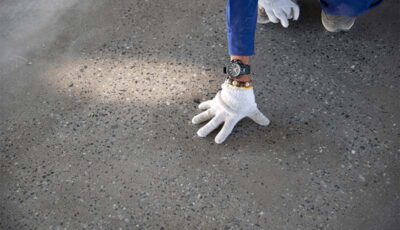
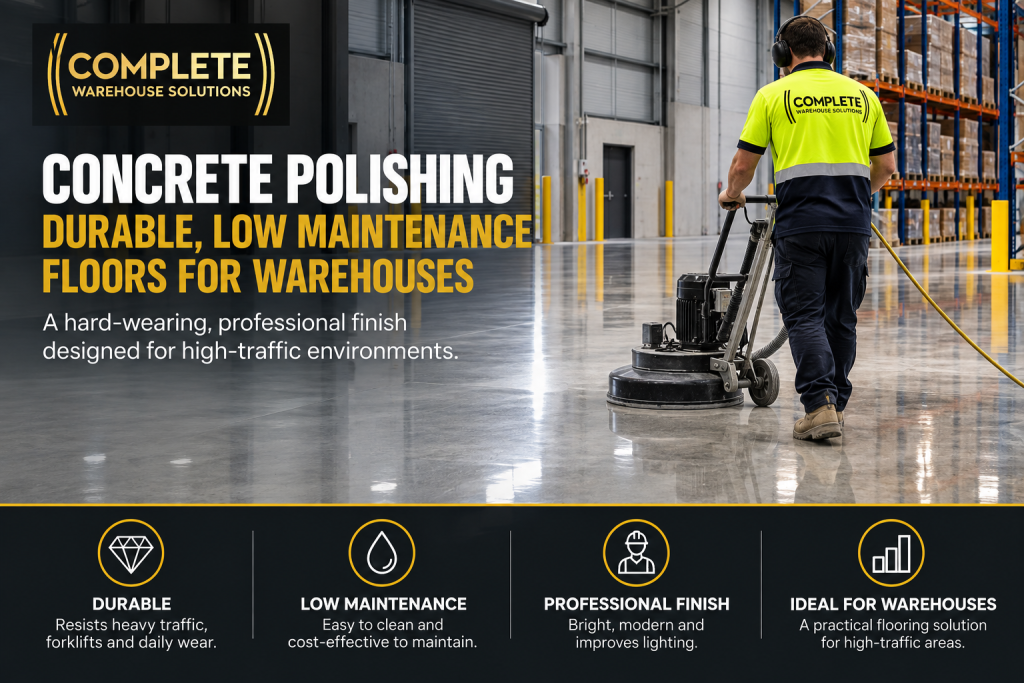
The best way to polish concrete is to use a controlled mechanical grinding and polishing process with progressively finer diamond abrasives, while properly preparing the slab before polishing.
The usual process is:
- Inspect the concrete.
- Repair cracks and surface defects where appropriate.
- Grind the surface.
- Progress through finer diamond abrasives.
- Apply a densifier where required by the polishing system.
- Continue polishing to the required finish.
- Apply any specified protective treatment.
- Clean and maintain the floor correctly.
Complete Warehouse Solutions describes concrete polishing as first grinding the concrete to remove surface imperfections, then using diamond polishing pads to produce the required finish from low-lustre matte through to a high-gloss appearance.
What Does Concrete Polishing Mean?
Concrete polishing is a mechanical process that progressively refines a concrete surface.
Rather than simply applying a glossy coating over the top, the surface itself is ground and polished.
The final appearance depends on:
- the existing slab
- aggregate exposure
- grinding depth
- polishing stages
- diamond grit
- densification
- required sheen
This means two polished floors can look very different even though both are correctly polished.
What Are the Steps for Polishing Concrete?
A commercial polishing job generally involves several stages.
1. Inspect the Existing Concrete
Before grinding begins, the floor needs to be assessed.
The contractor may look for:
- cracks
- coatings
- adhesives
- uneven areas
- surface damage
- contaminants
- previous repairs
- moisture issues
- concrete condition
This determines how aggressive the initial preparation needs to be.
2. Prepare the Floor
Preparation can involve removing:
- old coatings
- glue
- paint
- surface contaminants
- minor irregularities
Cracks, holes and damaged areas may also require treatment.
Good preparation matters because polishing will not magically hide every defect in the existing slab.
In many industrial situations, the condition and history of the floor largely determine the final appearance.
3. Grind the Concrete
The first mechanical stage uses diamond tooling to cut or grind the surface.
Complete Warehouse Solutions describes this stage as removing imperfections before the polishing process begins.
Grinding can also determine how much aggregate becomes visible.
A light grind may produce minimal exposure.
A deeper grind can reveal more stone and aggregate.
4. Refine the Surface
After the initial grinding stage, progressively finer abrasive tooling is used.
Each stage removes scratches left by the previous stage and makes the surface smoother.
Skipping stages can leave visible scratches and an inconsistent finish.
5. Densify the Concrete
Many polished-concrete systems use a liquid densifier during the process.
A densifier reacts with components in the concrete and helps create a harder surface that can be polished more effectively.
The exact product and stage depend on the polishing system and slab condition.
6. Polish to the Required Sheen
Diamond polishing pads are then used to refine the surface to the desired finish.
Complete Warehouse Solutions offers finishes ranging from lower-lustre matte through to glossy finishes.
The customer does not necessarily need the highest possible gloss.
A warehouse, showroom and retail floor may each suit a different finish.
7. Apply the Specified Protective Treatment
Depending on the system and intended use, a stain protector or penetrating treatment may be applied after polishing.
This can help make routine cleaning easier and reduce staining.
It should not be confused with applying a thick topical floor coating.
Which Tools Are Best for Polishing Concrete?
Professional concrete polishing typically uses purpose-built equipment.
This may include:
- planetary floor grinders
- industrial dust extraction
- diamond grinding tools
- progressively finer diamond polishing pads
- edge grinders
- crack-repair equipment
- polishing machines
- densifier application equipment
The tooling is selected according to:
- concrete hardness
- coating or adhesive removal needs
- desired aggregate exposure
- required final sheen
This is why concrete polishing is more involved than simply hiring a small floor polisher and running it over the slab.
How Do You Prepare Concrete Before Polishing?
Preparation is one of the most important stages.
The existing floor may first need:
- cleaning
- coating removal
- glue removal
- crack filling
- patch repairs
- levelling
- surface grinding
Complete Warehouse Solutions also provides concrete grinding, levelling, patching, resurfacing and sealing as part of its broader warehouse services.
That can be particularly useful where an older warehouse slab has been modified several times during its working life.
How Many Stages Are Needed to Polish Concrete?
There is no single fixed number.
The number of stages depends on:
- starting condition
- concrete hardness
- desired aggregate exposure
- final gloss level
- diamond tooling
- required appearance
A floor requiring a high-gloss finish generally needs more refinement than a floor intended to have a lower-lustre industrial appearance.
What matters is using a logical progression rather than jumping directly from aggressive grinding to fine polishing.
What Is Aggregate Exposure?
Aggregate is the stone contained within the concrete.
Grinding can expose different amounts of it.
Typical outcomes range from:
- little or no visible aggregate
- small amounts of aggregate
- medium exposure
- heavier aggregate exposure
The deeper the grinding, the more material is removed.
Existing slab conditions can make aggregate exposure inconsistent, so it is important to understand what can realistically be achieved before specifying the finish.
Is Polished Concrete Suitable for Warehouses?
Yes.
Polished concrete is commonly used in high-traffic commercial and industrial areas.
Complete Warehouse Solutions specifically identifies warehouses, retail spaces and other high-traffic facilities as suitable applications.
Advantages can include:
- durable surface
- straightforward maintenance
- no separate floor covering
- range of sheen levels
- clean industrial appearance
It can also work well during warehouse refurbishment and make-good projects where an existing slab needs to be restored.
Is Polished Concrete Worth It?
It can be a strong choice where durability and relatively simple maintenance are priorities.
Complete Warehouse Solutions highlights polished concrete as:
- durable
- long-lasting
- relatively affordable
- easy to clean
- available in different finishes.
Whether it represents good value depends on:
- existing slab condition
- required preparation
- floor area
- desired finish
- operational environment
A badly damaged slab may require significant preparation before polishing can begin.
What Are the Disadvantages of Polished Concrete?
Polished concrete is not ideal for every situation.
Potential drawbacks include:
Existing Damage Can Remain Visible
Cracks, patches and variations in old slabs may remain visible even after polishing.
It Is a Hard Surface
Concrete is physically hard underfoot, which may be uncomfortable in areas where people stand for long periods without appropriate matting.
Appearance Varies
Existing concrete is not a manufactured tile product.
Colour, aggregate and surface variation are part of the finished floor.
It Can Require Specialist Preparation
Old coatings, adhesives or damaged areas can increase labour and cost.
Gloss Can Show Dirt
Highly polished surfaces can make dust, tyre marks or contamination more noticeable.
For industrial spaces, a practical mid-sheen finish can sometimes make more sense than chasing the highest possible gloss.
Polished Concrete vs Epoxy: Which Is Better?
Neither is automatically better.
They are different systems.
Polished Concrete
Uses the existing slab itself as the finished surface.
It can suit:
- warehouses
- showrooms
- retail spaces
- commercial areas
- facilities wanting a durable exposed-concrete finish
Epoxy
Creates a coating over the concrete.
It may suit environments where the specification calls for:
- a coloured coating
- particular chemical resistance
- defined line marking
- a more uniform surface appearance
Complete Warehouse Solutions states that polished concrete can offer long service life and straightforward maintenance compared with coatings in many applications.
The correct choice depends on the site, use and required finish.
How Do You Keep Polished Concrete Looking Good?
Regular maintenance is relatively simple.
Good practice includes:
- removing dust and grit regularly
- cleaning spills promptly
- damp mopping where appropriate
- using cleaning products suitable for polished concrete
- avoiding harsh products that can dull or damage the finish
Complete Warehouse Solutions recommends regular dust removal and mopping and notes that a penetrating sealer can help maintain appearance.
Grit is important because small abrasive particles under forklift tyres, trolley wheels or foot traffic can gradually dull the surface.
How Long Does Polished Concrete Last?
A professionally prepared and maintained polished concrete floor can provide a long service life.
Complete Warehouse Solutions states that polished concrete should typically last at least ten years when properly installed and maintained.
Actual life depends on:
- traffic
- equipment movement
- maintenance
- contamination
- slab quality
- polishing system
A busy warehouse will place very different demands on a floor compared with a low-traffic office.
Can Existing Warehouse Concrete Be Polished?
Often, yes.
The key question is the condition of the slab.
An existing floor may require:
- coating removal
- glue removal
- grinding
- crack repairs
- patching
- levelling
before polishing begins.
Complete Warehouse Solutions handles concrete grinding, levelling, floor patching, resurfacing and sealing as part of warehouse refurbishment work.
This means polishing can often be incorporated into a wider warehouse make-good or refurbishment project.
Summary
The best way to polish concrete is through a staged mechanical process rather than simply applying a glossy product to the floor.
The process typically involves:
- inspection
- preparation
- grinding
- progressive diamond refinement
- densification where required
- final polishing
- protection and maintenance
The quality of the final result depends heavily on the condition of the slab and the preparation completed before the finishing stages begin.
For warehouses and commercial properties, professional concrete polishing can provide a durable and relatively low-maintenance finish while making use of the existing concrete slab.
What does concrete polishing mean?
Concrete polishing is a mechanical process that grinds and progressively refines the surface of a concrete slab using diamond abrasives.
What are the steps involved in polishing concrete?
The process generally includes inspection, preparation, grinding, progressively finer polishing stages, densification where required and final finishing.
Is polished concrete worth it?
It can be a practical option where durability, relatively simple maintenance and a clean commercial or industrial appearance are priorities.