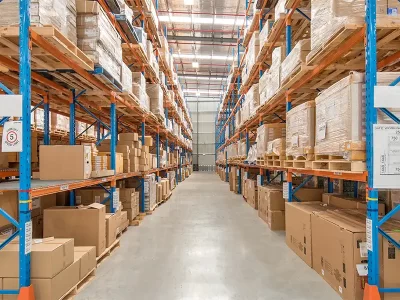
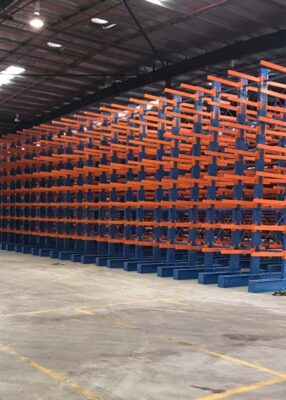
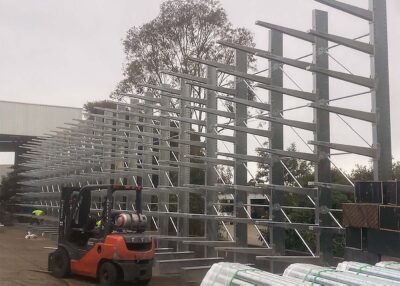
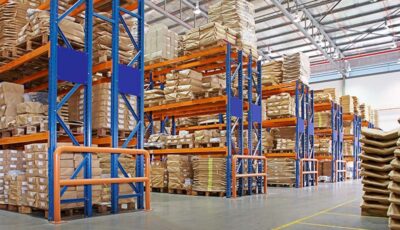
There is no single standard maximum height for warehouse racking.
The right height depends on the building’s clear height, pallet dimensions and weights, rack design, forklift reach, floor condition, fire protection requirements and the way stock moves through the warehouse.
Industrial pallet racks can make excellent use of vertical space, but the tallest possible system is not automatically the most efficient or appropriate solution.
What Is the Standard Height of Warehouse Racking?
There is no universal standard height for commercial pallet racking.
A warehouse racking system is generally designed around the particular building and the products being stored. Important factors include:
- available warehouse height
- pallet dimensions
- number of beam levels required
- pallet weights
- forklift lifting capacity
- aisle layout
- lighting and building services
- fire protection requirements
Complete Warehouse Solutions notes that pallet racking uses multiple horizontal storage levels to take advantage of vertical warehouse space without requiring additional floor area. Complete Warehouse Solutions
Some selective pallet racking configurations supplied by CWS can reach heights of up to approximately 15 metres, but that does not mean 15 metres is suitable for every warehouse. Complete Warehouse Solutions
How High Can Industrial Pallet Racks Safely Be Installed?
The safe height is determined by the design of the complete system.
Increasing rack height affects much more than the upright frame. It can change the loads placed on:
- beams
- uprights
- bracing
- floor anchors
- the concrete slab
It can also require different forklifts or materials-handling equipment.
SafeWork NSW advises that workplace racking should be specifically designed for the size, shape and weight of the products being stored and installed and maintained according to the manufacturer’s instructions. SafeWork NSW
So when businesses are comparing industrial pallet racks, height and capacity need to be considered together rather than independently.
What Factors Determine the Ideal Racking Height?
Warehouse Clear Height
The roof may be high, but not all of that height is necessarily usable.
Lighting, sprinklers, structural beams, ducts and other services can limit the height available for pallet storage.
Forklift Reach
The warehouse’s forklifts must be able to safely reach the required pallet positions.
Installing taller pallet racking may therefore require different materials-handling equipment, which can affect the overall project cost.
SafeWork NSW also states that the rack layout should be compatible with the equipment used in the workplace, including appropriate aisle widths for forklift turning circles. SafeWork NSW
Pallet Height
The height of loaded pallets affects how much vertical clearance is required between beam levels.
Lower pallet loads may allow additional storage levels, while tall stock can reduce the number of usable levels.
Pallet Weight
The weight of each pallet matters just as much as its size.
SafeWork NSW identifies two important rated capacities: the maximum individual unit load and the total rated capacity of each bay. Neither should be exceeded. SafeWork NSW
Are There Height Restrictions for Warehouse Storage Racks?
Yes, although they are not expressed as one simple maximum height that applies to every warehouse.
The design needs to consider the rack itself, stored loads, building and operating environment.
CWS’s current pallet racking information also notes an AS 4084:2023 requirement affecting end frames next to trafficable aisles: the frame needs to extend beyond the top load beam by at least 50% of the pallet height. Complete Warehouse Solutions
This is a good example of why the overall frame height and the height of the top storage level are not necessarily the same thing.
Is Higher Racking Always Better?
No.
Making better use of vertical space can increase warehouse capacity significantly, but very tall racking can also introduce trade-offs such as:
- more specialised forklifts
- slower access to upper pallets
- higher installation costs
- different aisle requirements
- additional fire-system considerations
The best industrial racking layout balances storage capacity with accessibility.
A business storing large quantities of similar stock may favour a high-density system such as drive-in racking, while businesses requiring frequent access to individual pallets may be better suited to selective pallet racking. Complete Warehouse Solutions
How Deep Is Normal Pallet Racking?
There is no single depth suitable for every pallet racking system.
Rack depth needs to suit the pallets and loads being stored.
CWS’s selective-racking information references the standard Australian pallet size of 1165 x 1165 mm, but warehouses may also handle other pallet sizes and imported pallets. Complete Warehouse Solutions
SafeWork NSW specifically warns that pallets that are too large or too small for the rack design can create safety problems. SafeWork NSW
The rack should therefore be designed around the actual pallets being used rather than choosing warehouse shelving racks purely from nominal dimensions.
What Is Racking Load Capacity?
Racking load capacity is the amount of weight that the particular components and configuration have been designed to support.
It may refer to:
- a beam level
- an individual pallet load
- a bay
- the overall rack configuration
This is particularly important when existing warehouse pallet racks are being relocated or reconfigured.
You cannot determine safe capacity simply by looking at the steel.
Can Existing Pallet Racking Be Made Taller?
Sometimes, but it should not be done simply by adding components.
Complete Warehouse Solutions regularly works with both new and used pallet racking, including systems that are relocated or reconfigured. CWS notes that altered or relocated racking needs to be considered against the current AS 4084 requirements. Complete Warehouse Solutions
Changes in height can affect:
- structural capacity
- beam spacing
- pallet clearances
- forklift requirements
- floor loading
- the overall stability of the system
This is why an existing pallet rack shelving system should be reassessed before being extended.
How Do You Choose the Right Warehouse Racking Height?
Start with what the warehouse actually needs to achieve.
Consider:
- What products are being stored?
- What are the pallet dimensions and weights?
- How frequently is each product accessed?
- What height can the forklift reach?
- How much clear building height is available?
- Are there doors, columns or services affecting the layout?
- Will stock requirements change as the business grows?
CWS considers storage density, building height, floor space, inventory access, stock rotation and load size when designing warehouse storage systems. Complete Warehouse Solutions
The aim isn’t to install the highest rack possible. It is to design the most useful storage capacity for the warehouse.
Summary
There is no universal maximum or standard height for warehouse pallet racking.
The correct height depends on the building, pallets, product weights, forklift reach, rack design and warehouse operation.
Using vertical space effectively can significantly increase storage capacity, particularly with industrial pallet racks, but height needs to be considered alongside load capacity, accessibility and material-handling equipment.
A properly designed system uses as much of the building as practical without compromising how the warehouse operates.
What is the standard height of pallet racking?
There is no single standard height. The rack configuration should be designed around the warehouse, loads, pallets and handling equipment.
What is the maximum height for a pallet?
There is no universal maximum pallet height. The pallet and load need to suit the racking design, available clearances and forklift being used.
What Australian Standards apply to pallet racking?
SafeWork NSW references AS 4084.1:2023 Steel storage racking – Design and AS 4084.2:2023 Steel storage racking – Operation and maintenance.