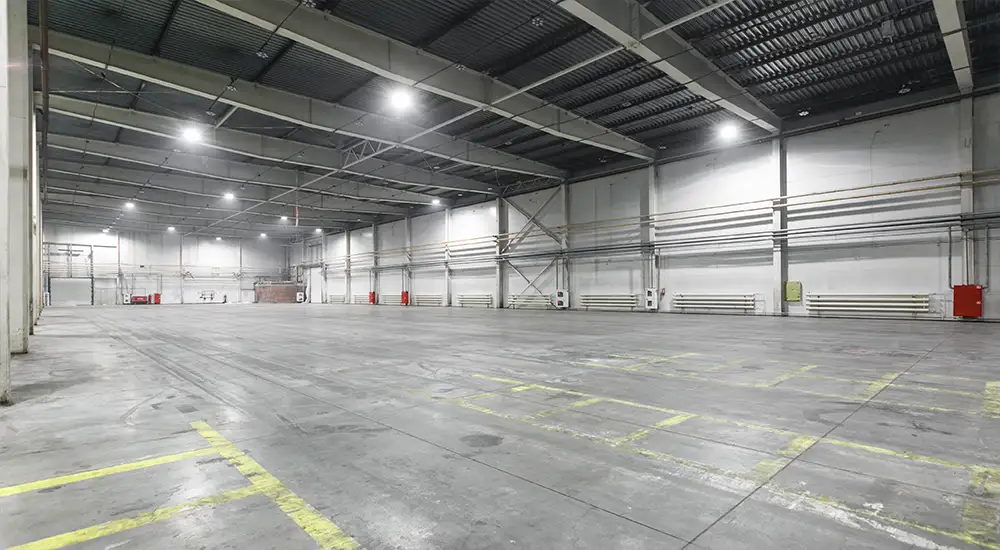
Polished concrete is often better for commercial and warehouse floors when durability, low maintenance and long-term usability are the main priorities. Epoxy, tiles and timber can all suit certain spaces, but they may not be the best choice for large working areas exposed to foot traffic, pallet movement, equipment or regular cleaning.
The best flooring option depends on how the space is used. A warehouse floor has different needs from an office, showroom, retail space or staff area.
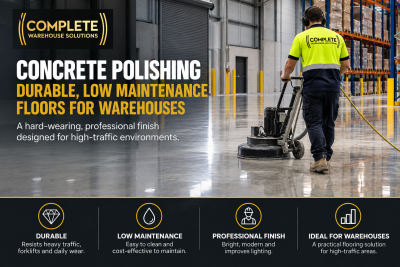
Complete Warehouse Solutions provides concrete polishing for warehouses, commercial spaces and industrial floors that need a practical, hard-wearing surface.
Quick comparison
| Flooring option | Best suited to | Main advantage | Main limitation |
|---|---|---|---|
| Polished concrete | Warehouses, workshops, showrooms, commercial floors | Durable and low maintenance | Existing slab condition matters |
| Epoxy | Areas needing a coated surface | Chemical resistance and colour options | Can wear, chip or need recoating |
| Tiles | Offices, amenities, retail areas | Clean decorative finish | Can crack or loosen under heavy use |
| Timber | Offices, hospitality, feature areas | Warm appearance | Higher maintenance and less suited to warehouse traffic |
For many warehouse and industrial spaces, polished concrete provides the strongest balance of durability, appearance and maintenance.
Polished concrete vs epoxy flooring
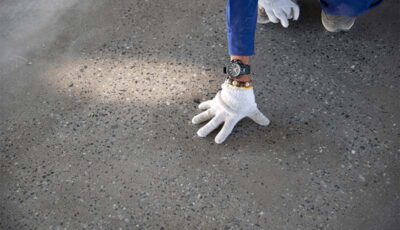
Epoxy flooring is a coating applied over the concrete surface. Polished concrete is created by grinding, densifying and polishing the concrete slab itself.
Epoxy can be useful where a specific coating, colour or chemical-resistant surface is required. However, in busy warehouse areas, coatings can be affected by impact, wear, moisture or poor slab preparation.
Polished concrete can be a better option when the business wants to use the existing slab as the finished floor.
Choose polished concrete when:
- the slab is suitable for polishing
- long-term durability is important
- a low-maintenance surface is preferred
- the space has large open floor areas
- the floor needs to handle regular commercial use
Choose epoxy when:
- the area needs a specific coating system
- chemical resistance is a priority
- colour zoning is required
- the slab is not suitable for polishing
- a sealed coating is more appropriate for the application
Polished concrete vs tiles
Tiles can work well in offices, bathrooms, lunchrooms, reception areas and retail spaces. They are less suitable for many warehouse floors because tiles can crack, loosen or become damaged under heavy commercial use.
A polished concrete floor is often more practical for large industrial areas because there are no grout lines, tile edges or individual pieces that can lift or break.
In a warehouse, fewer joints and transitions can also make cleaning and movement easier.
This is why polished concrete is commonly considered during warehouse fit outs and refurbishments.
Polished concrete vs timber
Timber can create a warmer appearance, but it is usually not the first choice for warehouse floors or heavy commercial areas.
Timber may be suitable for offices, display spaces or feature zones. However, it can scratch, dent, move with moisture and require more maintenance than polished concrete.
For practical warehouse use, polished concrete is usually stronger, easier to clean and better suited to equipment movement.
When polished concrete is the best choice
Polished concrete is often the best choice when the floor needs to be strong, clean and practical.
It may suit:
- warehouses
- workshops
- commercial fit outs
- showrooms
- industrial units
- storage areas
- dispatch zones
- mixed office and warehouse spaces
- refurbishment projects
It is especially useful when the existing slab is in reasonable condition and the business wants to avoid adding another floor covering.
When polished concrete may not be the best choice
Polished concrete is not suitable for every floor.
It may not be the best choice if:
- the slab is badly damaged
- the floor needs a soft finish
- acoustic comfort is a major priority
- chemical exposure requires a specialised coating
- the business wants a warm decorative timber look
- the floor needs a very specific non-slip coating
A proper site assessment is important before choosing any flooring system.
Is polished concrete high maintenance?
No. Polished concrete is generally low maintenance, especially compared with floor coverings that may crack, lift, stain or wear.
However, it still needs regular cleaning. Dust, grit, spills and contaminants should be removed to help protect the surface and maintain appearance.
For larger warehouse floors, suitable commercial cleaning equipment may be used.
Can you mop a polished concrete floor?
Yes. Polished concrete can usually be mopped with suitable cleaning products. The exact cleaning method depends on the finish, floor use and level of traffic.
For commercial areas, regular cleaning helps keep the floor presentable and functional.
Is polished concrete slippery?
Polished concrete can look glossy, but that does not automatically make it slippery. Slip resistance depends on the finish, cleaning routine, surface condition and whether the floor is wet, dusty or contaminated.
In warehouses, the floor should be assessed based on the actual use of the area.
Where this fits in a warehouse project
Flooring should be planned before installing storage systems, racking, line marking or work zones.
If the concrete floor needs polishing, repairs or preparation, it is often better to complete that work before installing pallet racking or finalising the warehouse layout.
This avoids unnecessary disruption and can create a cleaner result.
Internal links to add
Use these links naturally:
- concrete polishing
- warehouse fit outs
- pallet racking
- Existing blog: why choose polished concrete floors over tiles or wood
Summary
Polished concrete is often better than epoxy, tiles or timber for commercial and warehouse floors when durability, low maintenance and long-term use are the main priorities. Epoxy can suit areas that need a specialised coating, tiles can suit offices and amenities, and timber can suit feature spaces. For large warehouse floors, polished concrete often provides a practical balance of strength, appearance and easy maintenance.
FAQs
Is polished concrete better than tiles?
Polished concrete is usually more practical than tiles for warehouse and industrial floors because it is durable, easier to clean across large areas and does not have grout lines or individual tiles that can crack or loosen.
Is polished concrete better than epoxy?
It depends on the use. Polished concrete is often better for durability and low maintenance, while epoxy may be better where a specific coating, colour or chemical-resistant surface is needed.
Is polished concrete better than timber?
For warehouse and commercial working areas, polished concrete is usually more practical than timber because it is stronger, easier to clean and less affected by heavy use.
Is polished concrete slippery?
Not automatically. Slip resistance depends on the finish, surface condition, cleaning and whether the floor is wet or contaminated.