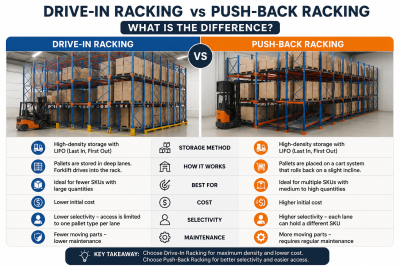
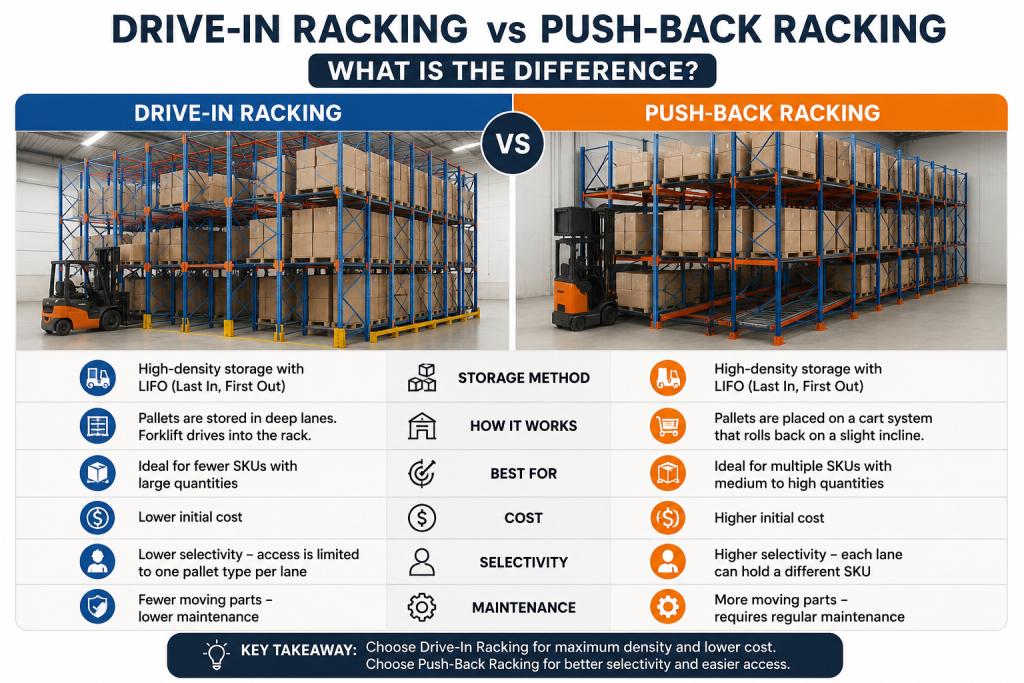
Drive-in racking and push-back racking are both high-density pallet storage systems, but they work differently. Drive-in racking usually saves more aisle space because forklifts drive into deep storage lanes. Push-back racking also increases storage density, but pallets are stored on carts or rails and pushed back from the aisle.
The better option depends on your stock type, pallet access needs, forklift movement, rotation method and warehouse layout.
For businesses trying to increase storage capacity, drive-in racking may be suitable when there are large volumes of similar products. Push-back racking may suit warehouses that need dense storage with better access from the aisle.
Drive-in racking vs push-back racking
| Feature | Drive-in racking | Push-back racking |
|---|---|---|
| Best for | Bulk storage of similar products | Dense storage with better pallet access |
| Forklift movement | Forklift enters the rack lane | Forklift stays in the aisle |
| Storage depth | Often very deep | Usually several pallets deep |
| Access | Lower selectivity | Better access than drive-in |
| Density | Very high | High |
| Stock rotation | Often last-in, first-out | Often last-in, first-out |
| Forklift risk | Higher because forklift enters racking | Lower because forklift works from aisle |
| Best use | Repeat pallets and bulk storage | Multiple lines needing denser storage |
Both systems can save space compared with standard selective racking, but the right system depends on how the warehouse operates.
What is drive-in racking?
Drive-in racking is a high-density pallet racking system where forklifts drive into the racking structure to store or retrieve pallets.
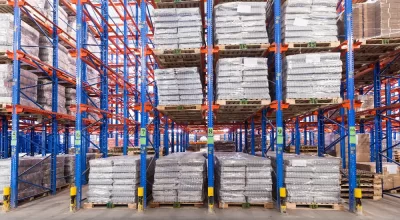
Pallets are stored on support rails, usually several pallets deep. This reduces the need for multiple aisles and allows more pallets to be stored in the same floor area.
Drive-in pallet racking works best when a warehouse stores many pallets of the same product.
What is push-back racking?
Push-back racking is a high-density storage system where pallets are loaded from the aisle onto carts or rails. When a new pallet is loaded, it pushes the previous pallet back into the rack.
When the front pallet is removed, the next pallet rolls or moves forward.
Push-back racking can provide good storage density while allowing the forklift to remain in the aisle.
Which system saves more warehouse space?
Drive-in racking can often provide higher storage density because it can use very deep storage lanes and reduce aisle requirements.
However, push-back racking may still save significant space while offering easier forklift access from the aisle.
In simple terms:
- Drive-in racking can maximise density.
- Push-back racking can balance density and access.
- Selective racking provides better access but uses more aisle space.
The best system depends on whether the warehouse needs maximum pallet count or better access to stored goods.
Which system is easier to operate?
Push-back racking is often easier to operate because the forklift usually stays in the aisle. The operator loads and retrieves pallets from the front of the rack.
Drive-in racking requires the forklift to enter the racking lanes. This can work well, but it needs careful forklift operation, clear lane design and regular racking inspections.
For busy warehouses, the operational difference can be important.
Which system is better for stock rotation?
Both drive-in and push-back racking are commonly used for last-in, first-out storage. This means the most recently stored pallet is often the first one removed.
This can work well for bulk storage, repeat products or stock that does not require strict rotation.
If first-in, first-out movement is required, another system may be more suitable, depending on the layout and product type.
When drive-in racking is better
Drive-in racking may be better when:
- maximum storage density is the priority
- there are large quantities of the same product
- pallet access does not need to be highly selective
- the warehouse needs to reduce aisle space
- stock movement is predictable
- forklift operators can safely work inside rack lanes
It is often used for bulk storage, seasonal goods, cold storage and repeat pallet loads.
When push-back racking is better
Push-back racking may be better when:
- the warehouse needs high-density storage
- forklift access from the aisle is preferred
- several product lines need dense storage
- faster pallet access is useful
- the site wants less forklift movement inside the rack structure
- stock rotation suits last-in, first-out handling
Push-back racking may suit warehouses that want more density than selective racking, but more access than drive-in racking.
Safety considerations
Both systems need proper design and installation.
Safety considerations include:
- correct load ratings
- pallet quality
- forklift compatibility
- rack protection
- aisle width
- floor condition
- operator training
- inspection routines
- damage reporting
Because drive-in racking places forklifts inside the rack structure, impact protection and operational discipline are especially important.
The racking system should be planned as part of the full warehouse fit out and storage layout.
How to choose the right high-density racking system
To choose between drive-in and push-back racking, ask:
- How many product lines are stored?
- How often are pallets accessed?
- Is maximum storage density the priority?
- Does stock need strict rotation?
- What forklifts are used?
- How much aisle space is available?
- Are pallet sizes and weights consistent?
- How important is direct access?
- Will the system support future growth?
If the business stores large volumes of similar stock, drive-in racking may be better. If the business needs dense storage with easier access, push-back racking may be better.
Internal links to add
Use these links naturally:
Summary
Drive-in racking and push-back racking both increase warehouse storage density, but they suit different operations. Drive-in racking can save more aisle space and maximise pallet capacity for large volumes of similar products. Push-back racking provides high-density storage while allowing forklifts to work from the aisle. Drive-in racking is often better for bulk storage, while push-back racking may be better when the warehouse needs density with easier pallet access.
FAQs
What is the difference between drive-in racking and push-back racking?
Drive-in racking requires forklifts to enter the racking lanes. Push-back racking allows pallets to be loaded from the aisle onto carts or rails that move pallets deeper into the rack.
Which saves more space, drive-in racking or push-back racking?
Drive-in racking can often save more aisle space, but push-back racking still provides high-density storage with easier access from the aisle.
Is drive-in racking cheaper than push-back racking?
The cost depends on the design, size, load requirements, warehouse layout and system complexity. Drive-in racking may be simpler, while push-back systems can involve more specialised components.